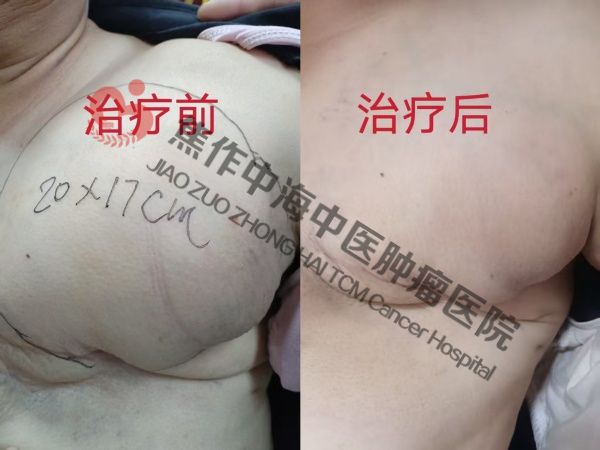
Supported by her family, 54-year-old Zhang Milan walked into the consultation room with a massive tumor measuring approximately 20×17 cm on her left chest wall. Her voice was weak, and her eyes were filled with despair yet lingering hope.
Nine years ago, she was diagnosed with left breast cancer and underwent surgical resection together with six cycles of chemotherapy. Not long after her condition stabilized, misfortune struck again: metastatic cancer appeared on her left chest wall. She received another seven cycles of chemotherapy, yet the tumor failed to shrink. On the contrary, it gradually developed into a huge mass, pushing her into utter despair.
Recommended by a friend, she came to Jiaozuo Zhonghai TCM Cancer Hospital in search of her last ray of hope. After a thorough diagnosis, Director Zhang Zhonghai pointed out that years of cancer fighting and repeated chemotherapy had left her body severely debilitated, presenting a TCM pattern of vital qi deficiency and lingering pathogenic toxins.
He formulated a personalized treatment plan centered on strengthening healthy qi while eliminating pathogenic factors. Herbal medicines such as astragalus and codonopsis were used to replenish qi and invigorate the spleen; radix ophiopogonis and polygonatum odoratum nourished yin and promoted fluid production; and oldenlandia diffusa cleared heat and detoxified toxins. Combined with the hospital’s characteristic hypoglycemic therapy, the integrated Chinese and Western medicine approach quickly reduced swelling and resolved masses.
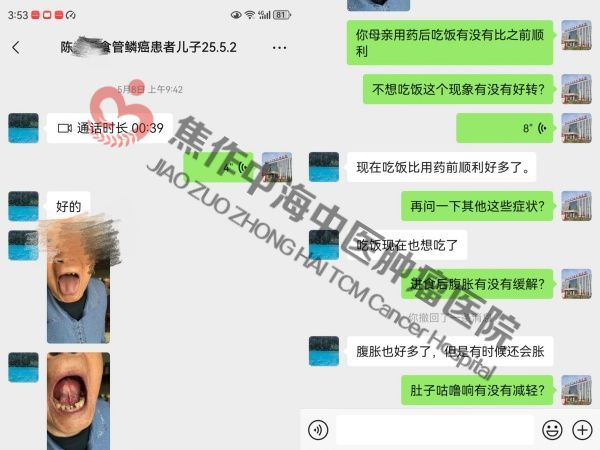
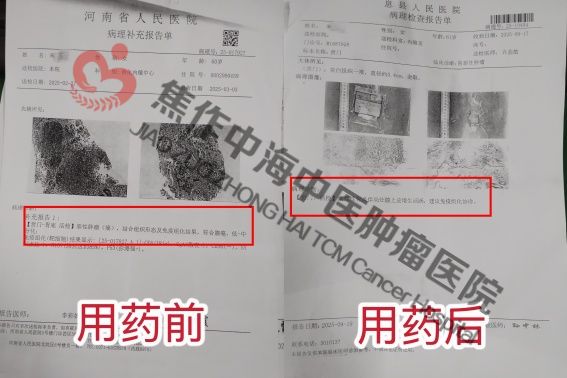
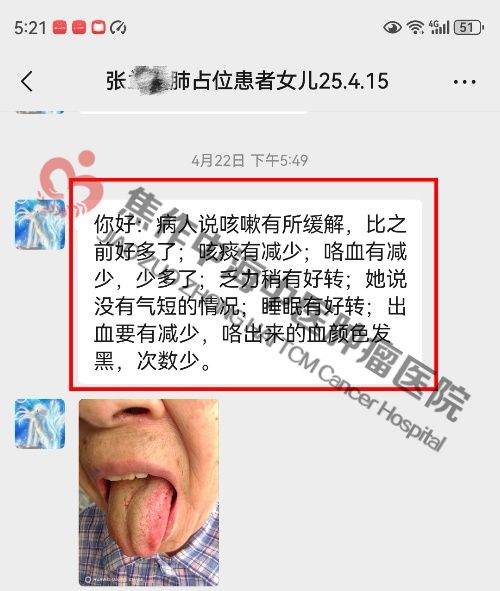
After 20 days of TCM conditioning and six sessions of hypoglycemic therapy, the chest mass softened and shrank noticeably. Her appetite and sleep improved, pain was relieved, and hope once again lit up her eyes.
“I am no longer afraid. Traditional Chinese medicine has given me the hope to live,” she said in a much clearer, stronger voice. “I will fully cooperate with the treatment and strive for a full recovery soon.”
As Director Zhang Zhonghai always emphasizes: “TCM cancer treatment never focuses merely on cancer cells, but views the patient as a complete whole. Our goal is not only to shrink tumors, but also to help patients live with quality and dignity.”