Ms. Li, a 72-year-old female patient with esophageal squamous cell carcinoma from Chaoyang District, Beijing, was treated at Jiaozuo Zhonghai TCM Cancer Hospital. She had a straightforward personality and was prone to getting anxious and “overheated” easily. Her diet particularly favored various pickled foods.
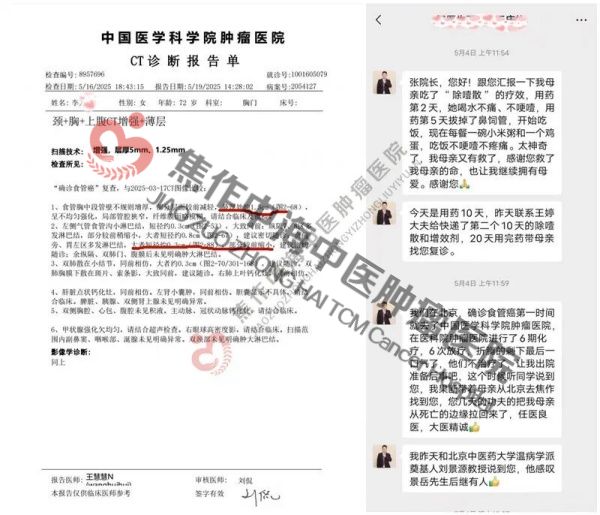
Six months ago, a sudden illness disrupted her peaceful later years. Initially, she only experienced occasional stomach discomfort and a choking sensation while eating, but the symptoms gradually worsened. She was eventually diagnosed with esophageal squamous cell carcinoma at the Cancer Hospital of the Chinese Academy of Medical Sciences, with the tumor located in the middle segment of the esophagus (25–30 cm from the incisor teeth).
Faced with this diagnosis, Ms. Li and her family immediately began standard treatment. Over the next six months, she underwent six cycles of chemotherapy combined with immunotherapy (paclitaxel + carboplatin + tislelizumab), with multiple adjustments to the regimen due to unsatisfactory efficacy. However, the disease continued to progress, and she eventually had to rely on nasogastric feeding to maintain nutrition. Subsequent radiotherapy (six sessions) was also interrupted due to concerns about potential esophageal fistula. At this point, Ms. Li’s health deteriorated rapidly: her weight dropped sharply from 66 kg to 61 kg, and her quality of life was severely compromised.
On April 24, 2025, recommended by relatives and friends, Ms. Li came to Jiaozuo Zhonghai TCM Cancer Hospital with a glimmer of hope. The scene at the initial consultation was heartbreaking: the 72-year-old could only move in a wheelchair, with a pale complexion and lethargic spirit. She described her suffering in detail to Director Zhang:
• For nearly a month, she had been completely unable to eat or drink by mouth; even drinking water caused severe pain, and she relied entirely on a nasogastric tube to sustain life.
• She frequently vomited yellowish-white mucus, had constant hiccups, and suffered from chest pain that made it impossible to sleep at night.
• The burning sensation from acid reflux made her condition even worse.
Examinations also revealed positive fecal occult blood, with 2–3 loose stools daily. Her sleep quality was extremely poor, and she would wake up at the slightest movement.
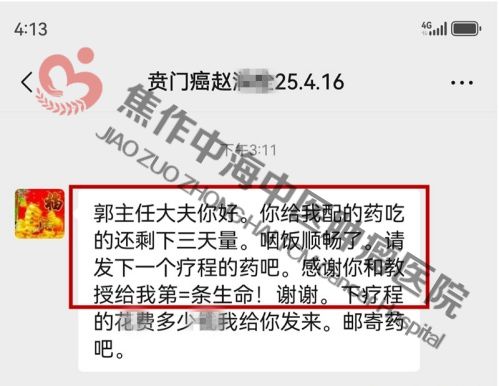
After a comprehensive evaluation, Director Zhang decided to treat her with the hospital’s characteristic preparation, “Chuye Powder,” initially prescribing a 10-day course to observe the effects. To everyone’s surprise, Ms. Li felt significant improvement on the second day of treatment: the pain and choking when drinking water were markedly reduced. By the fifth day, she was able to have the nasogastric tube removed. She could eat a bowl of millet porridge and one egg per meal without difficulty; dysphagia and pain were significantly relieved, and the production of sticky phlegm was greatly reduced. What made the family even more relieved was that Ms. Li’s weight began to increase and her strength gradually returned. She excitedly said she felt “saved from the brink of death.”
After 20 days of systematic treatment, Ms. Li’s recovery exceeded expectations. She can now comfortably eat soft foods such as noodles and eggs. Chest pain has basically disappeared, she can lie flat to rest at night, bowel and bladder functions have returned to normal, and her sleep quality has improved significantly. Watching their mother get better day by day, Ms. Li’s children highly praised the treatment results. This case not only demonstrates the unique advantages of TCM in cancer treatment but also brings confidence and hope to many patients facing similar challenges.