In May, wind carrying dust from the Loess Plateau blew through the window of 81-year-old Chen Meixiang.
She curled up on her kang, coughing violently, her throat feeling as if blocked by burning cotton.
Sticky phlegm stuck in her throat, impossible to spit out or swallow.
Her son squatted beside her, weeping silently — for ten days, since a nasogastric tube was inserted, his mother had not tasted a drop of water.
On May 7, a gastroscopy report from Jinzhengyuansheng Hospital in Linfen, Shanxi Province showed a proliferative mass extending from 20 cm below the incisors to the gastric fundus, leaving only a tiny opening in the esophagus.
Three days later, pathology confirmed esophageal squamous cell carcinoma.
Due to her advanced age and underlying hypertension and diabetes, open-chest surgery was not feasible, leaving only nasogastric tube feeding to sustain her life.
However, coughing worsened sharply after intubation, gastric fluid leaked from the corner of her mouth, and she lost 8 kg in just ten days.
On the recommendation of others, the son learned that
Kaidao Gao (Unblocking Ointment) from Jiaozuo Zhonghai TCM Cancer Hospital might relieve dysphagia in advanced esophageal cancer.
He immediately contacted Dr. Wang Tingting and brought his mother for treatment on May 12.
After taking her pulse, Dr. Wang explained that the patient suffered from
phlegm and blood stasis combined with fluid depletion.
Kaidao Gao, a pure Chinese medicinal preparation, was first used to resolve phlegm, unblock the orifices, and open the esophagus.
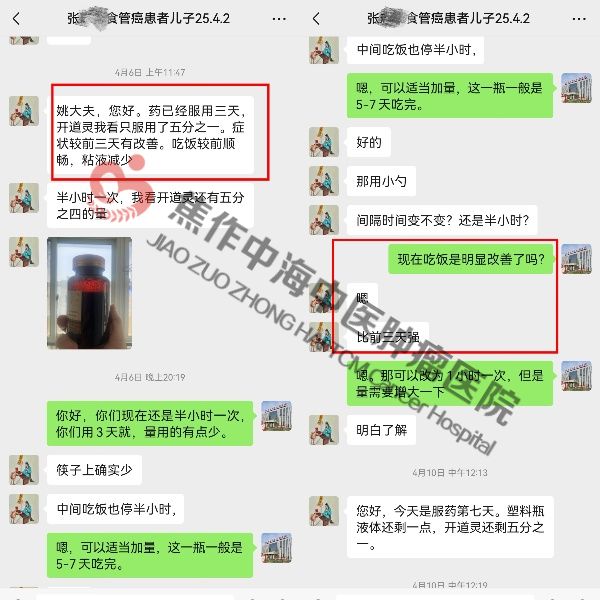
It is specially designed for terminal patients who cannot eat or drink at all, avoiding surgery or stenting, and usually restores oral intake within 3 to 7 days.
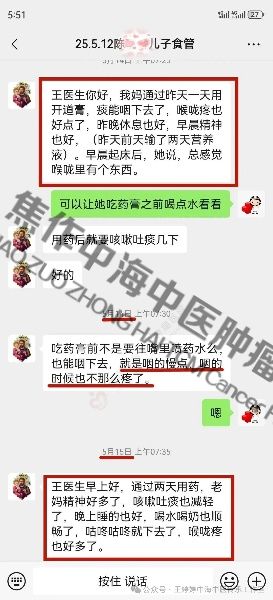
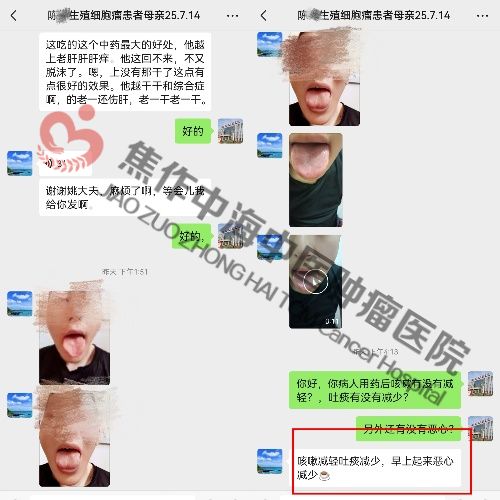
After the first day of treatment, the burning pain in her throat was significantly relieved and sticky phlegm gradually cleared.
Early the next morning, the son sent an excited voice message:
“Dr. Wang, my mom can drink water now!”
She successfully swallowed five spoonfuls of warm water that day.
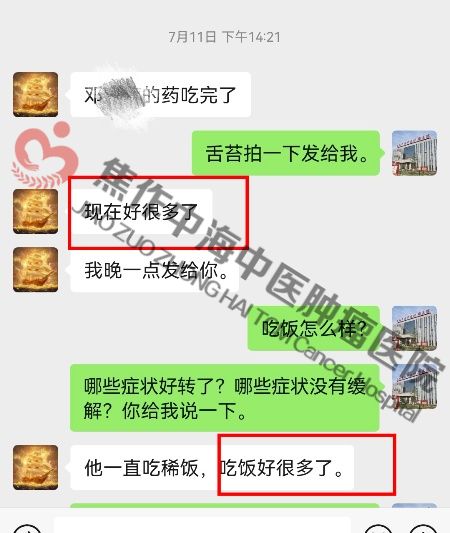
By the third day, she was holding a bowl and drinking milk on her own, not bothering to wipe the milk dribbling from her mouth.
During ward rounds, Dr. Wang found that the patient’s pulse had become strong, her tongue coating turned thin, and her sleep improved from constant nighttime coughing to five to six hours of continuous rest.
The elderly woman pointed to her nasogastric tube, eager to have it removed.
“Keep the treatment for two more days and we can remove the tube.
With spleen-strengthening herbs afterward, she will gradually be able to eat normally,” Dr. Wang instructed.
The son spoke loudly when calling relatives:
“I never expected Chinese medicine to be so miraculous!
My mom can now drink milk and eat egg custard…”