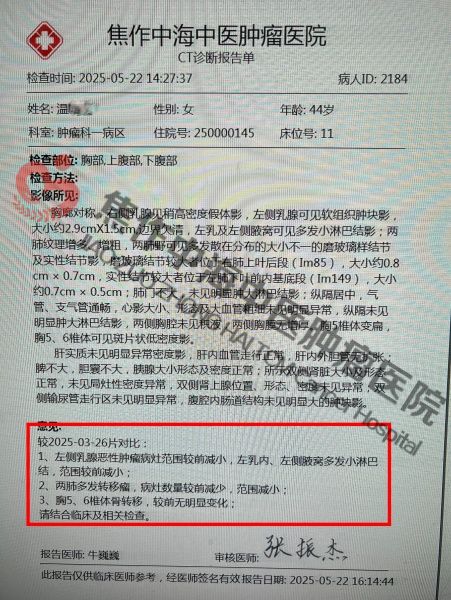
Ms. Li, a 41-year-old female patient with lung adenocarcinoma from Cangzhou City, Hebei Province, was treated at Jiaozuo Zhonghai TCM Cancer Hospital. Two months ago, she visited a local hospital due to a persistent dry cough accompanied by chest tightness, and was diagnosed with lung adenocarcinoma (complicated by multiple cervical lymph node metastases) via CT scan and pathological biopsy. The oncology department at the local hospital recommended combined radiotherapy and chemotherapy, but Ms. Li refused this conventional Western medical regimen out of concern for side effects and turned to traditional Chinese medicine treatment instead.
She took Chinese herbal medicine locally for more than a month, yet her symptoms showed no obvious improvement and even worsened: she suffered from a severe cough with copious, white, sticky phlegm; chest tightness and shortness of breath at night forced her to sleep in a semi-recumbent position; the cervical lymph nodes swelled to the size of pigeon eggs with obvious tenderness. She also had epigastric distension and poor appetite, which severely impacted her quality of life. Recommended by a fellow patient, Ms. Li came to our hospital for treatment.
After a thorough assessment of Ms. Li’s condition, Director Zhang formulated a treatment plan for her: an empirical TCM formula for lung tumors, modified according to her symptoms, combined with Hua’ai Xiaoliu Powder. A genetic test was conducted simultaneously, and targeted therapy with crizotinib was subsequently added to the treatment regimen for a combined approach.
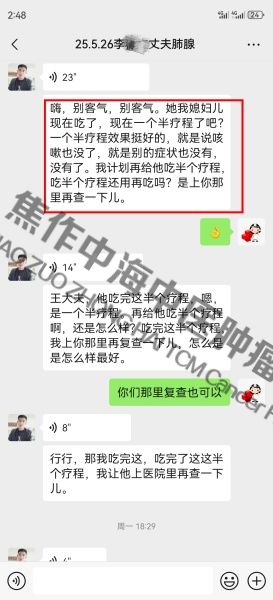
At the follow-up consultation after 30 days of treatment, Ms. Li’s symptoms improved remarkably: her cough, phlegm production, chest tightness and shortness of breath basically resolved, and the swollen cervical lymph nodes shrank significantly.